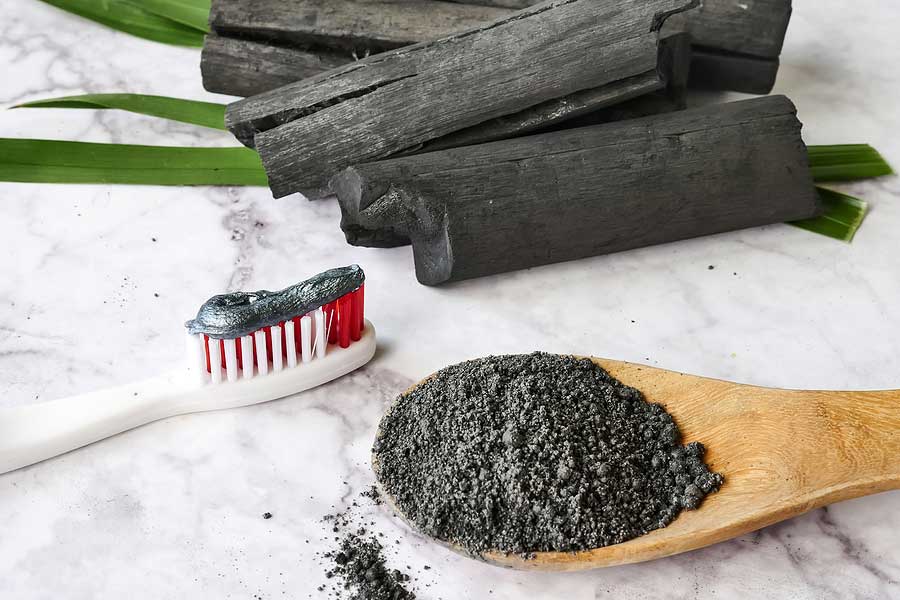
Pitch-black charcoal toothpaste has become a popular alternative to traditional toothpaste, often promoted as a “natural” way to whiten teeth, remove stains & freshen breath. It promises a brighter smile, but does the charcoal actually make your teeth whiter…or could it be doing more harm than good?
How Charcoal Toothpaste Works
Activated charcoal is a highly porous form of carbon that can adsorb certain substances onto its surface. It is a property that has useful applications in medicine & industry, but toothpaste manufacturers have extended the idea to oral care, suggesting charcoal can grab onto stains & impurities in the mouth.
In toothpaste, this proposed benefit is executed by the charcoal particles interacting with pigments on the tooth surface while the toothpaste’s abrasive ingredients physically scrub away surface stains caused by things such as coffee or tea. However, the charcoal toothpaste is primarily working on what is sitting on the tooth rather than chemically changing the natural color of the tooth itself.
Whitening Effectiveness
There is a difference between removing surface stains & bleaching teeth. Abrasive toothpastes can make teeth look cleaner or brighter by removing external surface discoloration, but true tooth bleaching requires peroxide-based products to chemically change the molecules responsible for deeper discoloration. Because charcoal toothpastes generally do not rely on peroxide bleaching agents, its whitening effect is largely limited.
A systematic review of laboratory studies found inconsistent evidence for charcoal’s whitening ability. Some studies found little or no significant difference compared with other toothpastes, & if anything, charcoal toothpastes tended to have greater abrasive potential. In a 2024 study summarized in the British Dental Journal, charcoal-based products generally performed similarly to conventional toothpaste for reducing staining, while charcoal powder produced more noticeable enamel wear.
Risks of Abrasion
More scrubbing does not automatically mean more whitening.
Some laboratory studies have found charcoal products to have relatively high abrasive potential, but it is noteworthy that this is not true of every charcoal toothpaste. A 2024 laboratory study of nine charcoal-containing dentifrices found that the charcoal products tested were not significantly more abrasive than their non-charcoal counterparts.
Hence, the ingredient of “charcoal” alone is not the villain. The formulation matters—including the type & amount of abrasive ingredients, the fluoride concentration & how aggressively the toothpaste is used.
The Purpose of Toothpaste
Toothpaste’s main job is to clean effectively while protecting enamel & preventing cavities.
For most people, there is little reason to choose charcoal toothpaste over a conventional fluoride toothpaste solely for potential whitening, especially if the product is highly abrasive or used aggressively. As an ingredient, fluoride is much more important to the fundamental purpose of toothpaste than the presence of charcoal.
However, if you enjoy using charcoal toothpaste, check the label carefully. Look for a fluoride concentration appropriate for adults—generally at least 1,350 ppm—&, if possible, choose a product with the ADA Seal of Acceptance. Avoid charcoal powders or highly abrasive DIY mixtures, particularly those combined with salt or other abrasive substances.
Charcoal toothpaste is not a magic whitening treatment, & no evidence shows that it is superior to conventional fluoride toothpaste. Some charcoal toothpastes may be perfectly reasonable products when they contain fluoride & are formulated appropriately, but many of the whitening claims surrounding charcoal are stronger than the science supporting them.
Sources
https://pubmed.ncbi.nlm.nih.gov/36183933/
https://www.nature.com/articles/s41415-024-6774-4
https://www.ada.org/resources/ada-library/oral-health-topics/whitening
https://pubmed.ncbi.nlm.nih.gov/39321106/
https://www.ada.org/resources/ada-library/oral-health-topics/toothpastes